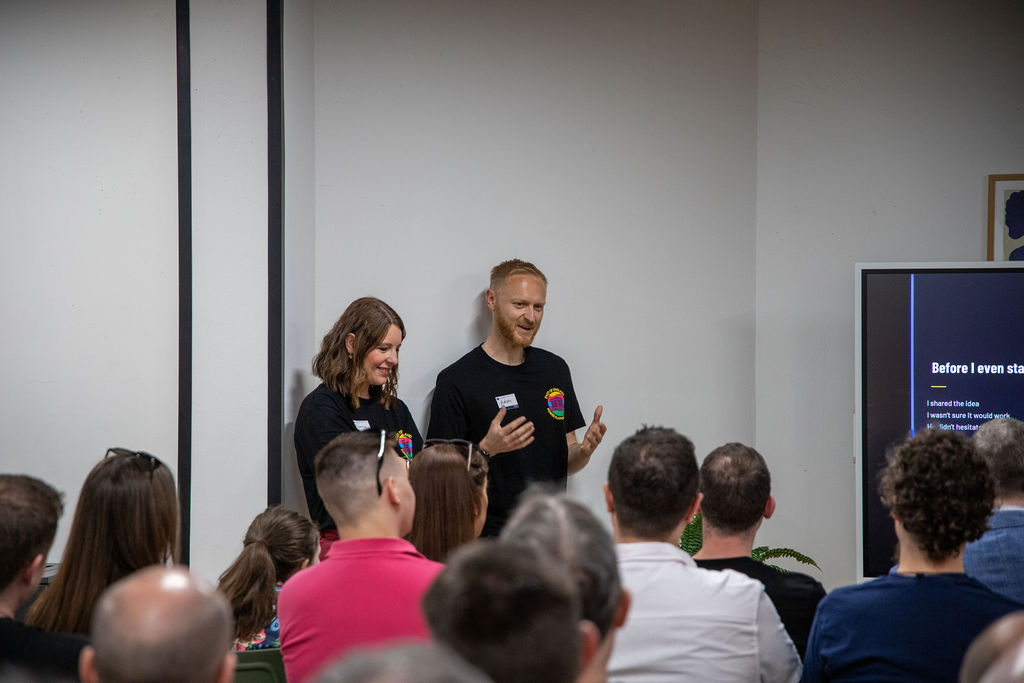
The East of England Power Platform Summit was co-founded and organised by my esteemed colleague, Adam Bezance.
I was more than delighted to travel to Norwich for the weekend to join Adam and soak it all up! From workshops to a keynote that had nothing to do with technology (more on that later…) here’s what stuck with me.
1. Should we be designing Power Apps like games?
Sandra Kiel delivered one of the summit’s most refreshing sessions, reframing Power Apps UX through the lens of game design. Her message was clear: business apps optimise for function, while games optimise for engagement, making progress visible, feedback rewarding and the next step unmistakably clear. The concept she returned to throughout was “momentum”.
Sandra challenged the traditional "doomscroll" approach, advocating instead for step-by-step interaction patterns that guide users forward. Rather than exposing every option at once, she emphasised hierarchy: a single primary “next” action (save/submit/continue), with secondary actions de-emphasised. Techniques like “chunking”, breaking processes into four stages with a visible progress indicator help users understand where they are and what’s coming next, turning tasks into a more intentional, journey-led experience.
Crucially,the experience is reinforced through detail. Micro-feedback builds confidence, while recovery-first error handling explains problems and offers a clear path forward. Even her more playful gamification ideas such as trophies, goals and mascots, pointed to a deeper principle: design for return, not just completion.
The takeaway was simple but powerful; adoption is as much a UX outcome as a technical one.
2. Your data doesn’t need to live in a dashboard to be useful
Renato Romao deSouza’s session showed how Fabric Data Agents and Copilot Studio turn governed, real-time data into conversational experiences with no code.
Most organisations have data which lives in a Lakehouse or Warehouse, it gets surfaced in a dashboard and someone needs to go and find it. The question Renato posed was: what if the data didn't just answer your question, but acted on the answer? That’s what the combination unlocks. A Fabric Data Agent sits on top of your data, with row level security and semantic context baked in, so responses are grounded and governed. Copilot Studio takes that capability and wraps it in a conversational agent that lives in Teams, on the web, or on mobile. The result is a Copilot that doesn’t just answer questions, it can draft summaries, trigger approvals, send notifications and update records.
.jpg)
3. The blueprint for scalable Power Apps
Geoff Ross delivered a highly practical session on “Named Functions” and repeatable design patterns for building scalable Canvas Apps. His focus was clear: not flashy UI, but maintainability, creating apps that are easier to extend, faster to iterate and consistent across environments and teams.
At the heart of his approach was a disciplined shift: moving logic out of controls into a defined configuration layer. Rather than scattering formulas across screens, Geoff advocated centralising logic through Named Functions and formulas, with tables driving behaviour. In this model, controls become lightweight, referencing predefined logic instead of embedding business rules directly in the UI.
This separation enables environment-aware configuration without refactoring,supports truly data-driven apps via tools like Dataverse and keeps components clean of hidden logic or hard-coded values. The result is a more predictable development model. Once the configuration layer is in place, makers can focus on UX and flow. With tools like VS Code supporting this approach, app behaviour becomes more like code: structured, reviewable and reusable.
4. Testing tips & tricks for Power Platform
Keith Atherton and Melissa Hale brought an Alien-inspired (yes – the movie!) energy to a topic too often left until the last minute: testing. Their message resonated across both technical and business audiences: QA safeguards delivery timelines, user trust and team sanity.
They outlined a practical approach to test planning, covering everything from clear acceptance criteria to the full testing spectrum: unit, integration, system, performance, security and UAT, alongside reporting and metrics to surface risks early.
The session was packed with actionable tooling. Platform-native options like Monitor, Solution Checker and Test Studio were complemented by Playwright and Azure DevOps for more structured automation pipelines. They also highlighted accelerators, including using Copilot to draft test cases, Copilot Studio evaluations and generating realistic test data with tools like Mockaroo, helping teams move faster without compromising quality.
The takeaway was simple: don’t wait for an incident, find the bugs first.
5. It’s not always about technology
The event’s keynote, by Chris Huntingford, didn’t feature a single product update or live demo. He talked about people, the human element, the value of keeping humans in the loop, and what happens when a community shows up for each other.
In a space moving as fast as this one, agentic AI, Fabric integration, vibe coding, it’s easy to spend every waking hour with our heads down on delivery. Events like the East of England Power Platform Summit exist to lift your head up, see what others are building and return to work with some great ideas that you didn’t have before.
The keynote was a timely reminder of why community matters and, for me, that was worth travelling on a Saturday to Norwich! I can't wait for next year's! For more details check out the East of England Summit’s website.
.jpg)
.jpg)
.jpg)